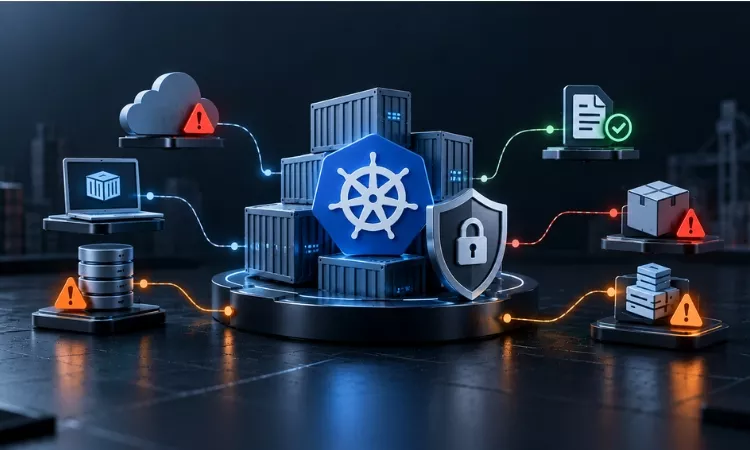











Enterprises now run core business systems across AWS, Azure and Google Cloud, and every one of those platforms exposes thousands of configurable settings. Engineering teams change those settings daily through consoles, scripts and infrastructure-as-code pipelines, often under delivery pressure and without a security review. A single change can expose sensitive data to the internet within seconds. Two common examples are opening a storage bucket for a quick data transfer and granting a broad IAM role during a migration. Traditional audits review this environment a few times a year, so they miss the configuration drift that happens between assessments.
This guide covers three things:
- What cloud security posture management (CSPM) is?
- How misconfigurations turn into breaches?
- How security leaders can use CSPM to keep cloud environments secure and audit-ready?
What Is CSPM And How Does Cloud Security Posture Management Work?
CSPM is both a security discipline and a category of tools. It continuously scans cloud environments for misconfigurations, compliance violations and risky permissions. It then ranks those findings and helps teams fix them. It works by connecting to cloud provider APIs with read-only access and comparing every resource against security benchmarks and internal policies.
A typical CSPM workflow moves through four connected stages:
- Discover: Build a live inventory of accounts, subscriptions, storage, compute, identities and network resources.
- Assess: Compare each resource against frameworks such as the CIS Benchmarks, NIST and provider security baselines.
- Prioritize: Rank findings by exposure, data sensitivity and exploitability so that teams fix the riskiest issues first.
- Remediate: Route findings to owners through ticketing tools or apply automated fixes for well-understood issues.
The core value of CSPM lies in continuous monitoring. It replaces a periodic snapshot with a constant view of how your cloud is configured right now.
Why Are Cloud Misconfigurations So Common In Enterprise Environments?
Cloud misconfigurations are common for two reasons. Cloud platforms change faster than manual controls can track, and the customer remains responsible for configuring them securely. In its Top Threats to Cloud Computing 2024 report, the Cloud Security Alliance ranked misconfiguration and inadequate change control as the number one threat.
Several organizational factors drive this pattern across large enterprises:
- Developers provision infrastructure directly, often without security expertise in the loop.
- Default settings on many services favor usability over security.
- Multi-account and multi-provider estates create inconsistent policies across teams.
- Temporary access granted during projects is rarely revoked afterward.
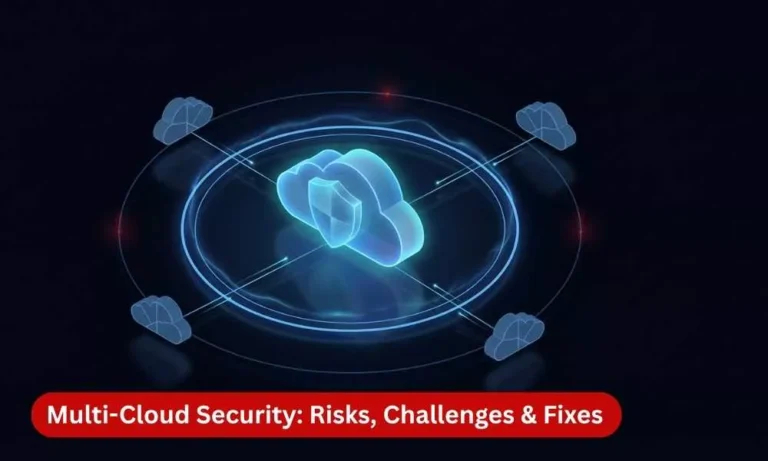
The challenge grows quickly with scale, because most enterprises run hundreds of cloud accounts. A multi-cloud security strategy needs one consistent policy layer across all of them.
How Do Cloud Misconfigurations Turn Into Data Breaches?
Cloud misconfigurations turn into breaches in three steps:
- An attacker finds an exposed resource.
- The attacker exploits a weak permission on it.
- The attacker uses that foothold to reach sensitive data.
Attackers run automated scanners around the clock. Those scanners search the internet for open storage, exposed management ports and leaked credentials.
The Tenable Cloud Security Risk Report 2025 found that 9% of publicly accessible cloud storage contained sensitive data. It also found that 97% of that data was classified as restricted or confidential. The same research found that 29% of organizations still had a “toxic cloud trilogy.” That term describes a workload that is publicly exposed, critically vulnerable and highly privileged at the same time.
The Capital One breach in 2019 remains the clearest example of this chain. A misconfigured web application firewall allowed a server-side request forgery attack. An over-permissive IAM role then let the attacker retrieve credentials and copy data from storage buckets. The breach affected roughly 106 million people and led to an $80 million regulatory penalty. Each weakness looked minor in isolation, and together they created a direct path to sensitive data.
What Are The Most Common Cloud Misconfigurations CSPM Detects?
The most common cloud misconfigurations CSPM detects are the following:
- Public Storage
- Excessive IAM Permissions
- Exposed Secrets
- Open Network Ports
- Disabled Logging
In our cloud security assessments, the most frequent high-risk finding is an IAM role with administrator or wildcard permissions. That role is often attached to a workload that never needed it.
| Misconfiguration | Why it matters |
| Public storage buckets or blobs | Exposes data directly to the internet |
| Wildcard or admin IAM permissions | Turns a single compromise into full account control |
| Secrets in code, task definitions or user data | Hands attackers ready-made credentials |
| Security groups open to 0.0.0.0/0 | Exposes SSH, RDP and databases to scanning |
| Disabled logging or monitoring | Removes the evidence needed for detection and audits |
| Unencrypted volumes and snapshots | Weakens data protection and compliance evidence |
Secrets exposure deserves special attention from security leaders. Tenable found that 54% of organizations stored at least one secret directly in AWS ECS task definitions, where anyone with read access can retrieve it.
How Is CSPM Different From CNAPP, CWPP And CIEM?
Each of these four tool categories covers a different layer of cloud risk:
- CSPM: Checks how cloud services are configured, such as storage, networking and encryption settings.
- CWPP (Cloud Workload Protection Platform): Protects virtual machines, containers and serverless functions at runtime.
- CIEM (Cloud Infrastructure Entitlement Management): Analyzes human and machine identities to remove excessive permissions.
- CNAPP (Cloud-Native Application Protection Platform): Combines CSPM, CWPP, CIEM and code scanning to connect risks from development to runtime.
For most enterprises, CSPM forms the foundation of a cloud security program. Many organizations start with CSPM to gain visibility. They then expand into CNAPP as their cloud-native footprint grows.
How Does CSPM Support PCI DSS, SOC 2, ISO 27001 And HIPAA Compliance?
CSPM supports compliance by mapping cloud configurations to framework controls. It also produces continuous evidence that those controls are working. Teams no longer need to collect screenshots before an audit. They can show auditors a timestamped record of configuration status across the full audit period.
- PCI DSS v4.0.1: CSPM helps validate secure configurations, network segmentation and logging for systems in the cardholder data environment.
- SOC 2: CSPM produces evidence for logical access, change management and monitoring criteria.
- ISO 27001: CSPM supports Annex A controls on configuration management, logging and cloud service security.
- HIPAA: CSPM helps confirm encryption and access controls for systems that store electronic protected health information.
This continuous approach directly reduces compliance drift, where an organization passes an audit and then slowly falls out of alignment. It also strengthens audit readiness, because evidence exists before auditors request it.
What Should CISOs Look For When Implementing CSPM?
CISOs should look for five capabilities in a CSPM program: complete multi-cloud coverage, risk-based prioritization, framework mapping, workflow integration, clear remediation ownership. A CSPM tool that produces thousands of unranked alerts will overwhelm teams. It will also fail to reduce real risk.
A practical CSPM implementation plan includes the following steps:
- Connect every cloud account, including development and sandbox environments that attackers often target first.
- Define which frameworks and internal policies apply to each environment.
- Assign remediation owners for every account or business unit.
- Integrate findings with ticketing, SIEM and infrastructure-as-code pipelines so fixes happen at the source.
- Track metrics such as mean time to remediate critical findings and the % of accounts meeting baseline.
Tools alone rarely close the posture gap in large cloud estates. An independent cloud security assessment validates what CSPM reports. Managed cloud security services help teams turn findings into lasting fixes.
| Find and fix the cloud misconfigurations attackers exploit first by scheduling a cloud security posture assessment with Ampcus Cyber. |
People Also Ask
Is CSPM agent-based or agentless?
Can CSPM fix misconfigurations automatically?
Who is responsible for cloud misconfigurations?
What is the difference between CSPM and a cloud security assessment?
How quickly should critical cloud misconfigurations be fixed?
Enjoyed reading this blog? Stay updated with our latest exclusive content by following us on Twitter and LinkedIn.