





Enterprise data now moves through cloud collaboration suites, SaaS platforms, generative AI tools, and partner portals faster than most security teams can inventory it. A customer spreadsheet can reach a personal inbox, a public repository, or an AI prompt window within minutes. Regulators have taken notice. GDPR Article 32 requires controls proportionate to risk, HIPAA requires safeguards for protected health information, and PCI DSS requires entities to know where cardholder data resides. Each obligation assumes the organization can separate sensitive data from everything else. A data classification policy provides that separation and gives every downstream control a consistent basis.
What Is a Data Classification Policy?
A data classification policy is a formal governance document that defines how an organization categorizes information by sensitivity, which labels mark each category, and which handling rules apply. It assigns ownership for classification decisions and sets minimum controls for storage, transmission, sharing, and disposal. Every decision it governs answers one question: how much harm would follow if this information were disclosed, altered, or lost?
The policy serves as the reference point for other controls. Access reviews, encryption standards, data loss prevention rules, and retention schedules all depend on knowing what the data is. Without a policy, teams protect information by habit. Restricted records then sit beside public marketing material with identical safeguards, or routine files get locked down so tightly that staff route around the rules.
What Are the Standard Data Classification Levels?
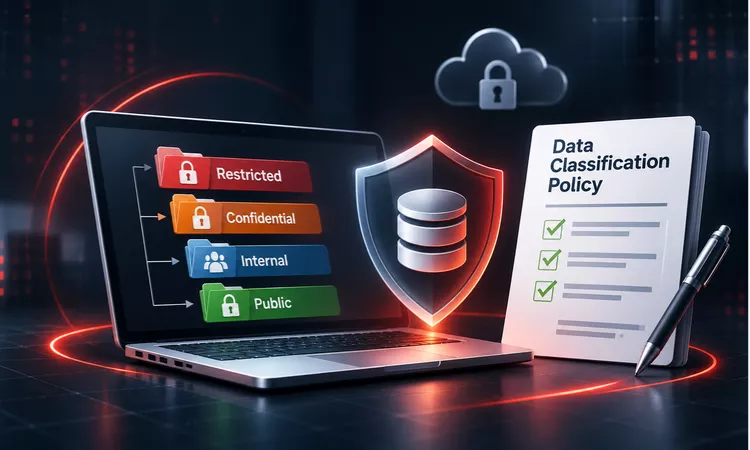
Most enterprises use four levels: Public, Internal, Confidential, and Restricted. Some sectors add a fifth tier for especially sensitive material, such as Secret in defense contracting or Highly Confidential for merger activity. The number of levels matters less than the criteria behind each one.
- Public: Information approved for release outside the organization, such as published product documentation and press releases. Disclosure causes no material harm.
- Internal: Information meant for employees and contractors, such as internal policies and organizational charts. Unauthorized disclosure creates limited embarrassment or operational friction.
- Confidential: Information whose exposure would harm the business or breach a contractual duty, such as customer contracts, financial forecasts, and performance reviews.
- Restricted: Information whose exposure would cause severe financial, legal, or safety harm, such as cardholder data, protected health information, cryptographic keys, and unannounced acquisition plans.
Each level needs written criteria tied to impact. The NIST Computer Security Resource Center publishes FIPS 199 and NIST SP 800-60, which rate information by low, moderate, and high impact across confidentiality, integrity, and availability. Many enterprises borrow that logic. A clear mapping lets a sales analyst decide whether a file is Confidential without escalating every case to a security architect.
What Handling Rules Should Each Level Carry?
Handling rules convert a label into behavior. They specify who may access the data, how it may be shared, whether encryption is required, and how long it may be retained.
| Level | Access Rule | Sharing Rule | Storage Requirement |
| Public | Open | No restriction | Standard retention |
| Internal | Employees and approved contractors | Internal channels only | Corporate repositories |
| Confidential | Named roles with business need | Approved external recipients under NDA | Encrypted at rest and in transit |
| Restricted | Named individuals, reviewed quarterly | Prohibited outside controlled channels without written approval | Encrypted, logged, and segregated |
Restricted data needs the strictest controls because a single misdirected file can trigger notification duties, contractual penalties, or regulatory action. Quarterly access reviews for that tier surface stale permissions before they become incidents.
How Do Data Labels Work in a Classification Program?
Data labels are markers that show a file’s classification level. They appear as headers, footers, watermarks, or embedded metadata. A label turns a policy decision into something that a person, a device, or a security tool can read. Microsoft Purview sensitivity labels, for example, can apply encryption and access restrictions automatically when a document carries a Restricted tag.
Labels work best at the point of creation. Manual labeling depends on memory and judgment, and it degrades under deadline pressure. Automated classification uses pattern matching to detect card numbers, national identifiers, or health record codes, then prompts the author to confirm the result. Most mature programs combine both methods. ISO/IEC 27001:2022 Annex A control 5.13 covers labeling of information and expects labels to follow the organization’s classification scheme.
Why Does a Data Classification Policy Matter for Compliance?
A data classification policy shows regulators and auditors that the organization knows where its sensitive data sits and treats it accordingly. PCI DSS requires entities to identify and document where cardholder data is stored, processed, and transmitted, and Requirement 12.5.2 calls for scope confirmation at least every 12 months. Without classification, that scoping exercise has no reliable starting point.
Classification also supports cross-border obligations. A data set tagged Restricted that contains EU personal data may trigger transfer restrictions under GDPR Chapter V, a risk a generic security policy would never surface. Organizations that map classification to control frameworks shorten audit preparation considerably. The PCI Security Standards Council publishes the current PCI DSS requirements that define cardholder data scope.
Compliance Compass from Ampcus Cyber maps classification tiers to the controls each framework expects.
Who Should Own the Data Classification Policy?
The CISO or a senior data governance lead should own the policy. Business data owners classify the information their teams create and use, because they understand the commercial and legal impact of that information. Security defines the standard and monitors adherence. Legal and records management teams advise on retention periods and statutory duties.
This division prevents two common failures. Security teams cannot classify every file in the enterprise, and business teams cannot be expected to interpret encryption requirements. Clear ownership lets each group do the part it understands best.
How Do You Build a Data Classification Policy Template?
A usable template contains eight sections. Each section should stay concise enough that a non-specialist can apply it without a glossary.
| Section | What to Include |
| Purpose | The business and regulatory reasons for classifying data |
| Scope | Systems, business units, data types, and third parties covered |
| Definitions | Terms such as data owner, data custodian, and personal data |
| Classification Levels | Each level with its impact criteria and example data types |
| Labeling Requirements | Which labels apply, where they appear, and who applies them |
| Handling Rules | Access, sharing, storage, and disposal requirements per level |
| Roles and Responsibilities | Owners, custodians, security, legal, and staff duties |
| Review and Exceptions | Review frequency, exception approval path, and violation response |
For example, a Confidential customer contract template might state that the document carries a header label, is accessible to the account team and legal counsel, and may be shared externally only through encrypted links under an executed NDA. That specificity makes the policy enforceable.
What Mistakes Weaken a Data Classification Program?
Three failures account for most underperforming programs. Each one has a structural cause and a structural fix.
- Too many levels: Seven tiers with overlapping definitions produce inconsistent labels. Four or five well-defined levels give staff a decision they can make in seconds.
- Criteria without examples: A definition such as “significant harm” means different things to different teams. Attaching sample data types to every level makes the policy usable.
- No link to enforcement: A policy that no tool reads stays a document. Connecting labels to access controls and data loss prevention rules turns the policy into operating behavior.
Programs that avoid these mistakes treat classification as a living control. They review levels annually, retrain data owners after organizational changes, and audit label accuracy on a sample basis.
| Ready to turn your classification policy into enforceable controls? Contact Ampcus Cyber to scope a policy review aligned with ISO 27001, PCI DSS, and GDPR obligations. |
People Also Ask
What is the purpose of a data classification policy?
It defines how information is sorted by sensitivity and what protections each category requires, so controls apply consistently.
What are the four levels of data classification?
Most enterprises use Public, Internal, Confidential, and Restricted, though some sectors add a fifth tier for highly sensitive material.
What is the difference between data classification and data labeling?
Classification is the decision about a data set’s sensitivity. Labeling is the visible or embedded marker that records that decision.
Does PCI DSS require data classification?
PCI DSS does not name a classification scheme. It does require entities to identify where cardholder data resides, which classification makes practical.
How often should a data classification policy be reviewed?
Annual review is common, with earlier updates after major changes in regulation, systems, or business structure.
Enjoyed reading this blog? Stay updated with our latest exclusive content by following us on Twitter and LinkedIn.