








Regulatory obligations for enterprise security programs have multiplied faster than most internal teams can track. PCI DSS made its future-dated requirements mandatory on March 31, 2025.
The Digital Operational Resilience Act (DORA) began applying to EU financial entities in January 2025. The NIS2 Directive is also redefining cybersecurity duties for essential and important entities across the European Union. Each framework raises the same question for the CISO: where does the current control environment fall short of what regulators, auditors, and customers expect?
Boards want a defensible answer before an examiner or an incident supplies one. A compliance gap assessment provides that answer in a structured, evidence-based form.
What Is a Compliance Gap Assessment?
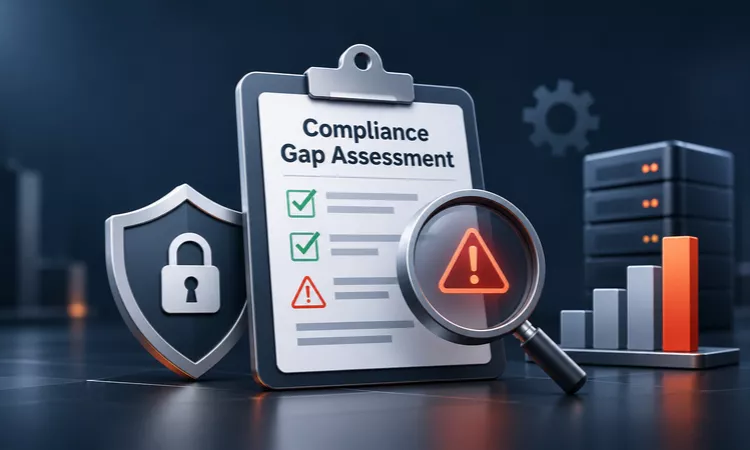
A compliance gap assessment compares an organization’s current security controls, policies, and processes against the requirements of a target standard or regulation. It identifies controls that are missing, partially implemented, or ineffective. It then ranks each shortfall by risk and business impact, producing a prioritized remediation roadmap.
The assessment measures the distance between where the organization stands and where the standard requires it to be. It does not certify compliance. That distinction matters when findings reach the board. A gap assessment is a management tool for deciding what to fix first, while certification is an external judgment on whether the fixes are sufficient.
Why Does a Compliance Gap Assessment Matter for Enterprise Leaders?
It converts regulatory exposure into a ranked list of funded decisions. Without a documented baseline, a CISO cannot show a regulator when the organization identified a weakness, how it assessed the risk, and what it did in response. That record forms the core of defensible due diligence.
Regulatory Liability and Documented Oversight
Regulators judge intent and response as well as outcome. A gap assessment that records known deficiencies, assigned owners, and target dates shows that leadership exercised oversight. An organization that knew about a gap and left it undocumented carries far more exposure than one that tracked and funded remediation, even when both experienced the same control failure.
Third-Party Risk Visibility
Third-party risk management (TPRM) depends on the same discipline. A gap assessment that extends to critical vendors reveals whether a payment processor, cloud provider, or managed service holds the controls your framework assumes it holds. The PCI Security Standards Council publishes current requirements for service providers, which makes vendor gaps a direct compliance issue rather than a procurement detail.
How Does a Compliance Gap Assessment Work?
It moves through five phases, and each phase produces the evidence the next one depends on. Ampcus Cyber aligns these phases with its T-SAMA methodology (Train, Scope, Assess, Mitigate, Audit), which keeps the assessment connected to the remediation and audit cycle that follows.
- Scope the assessment: Define the framework, business units, systems, and third parties inside the boundary. Scope errors are the most common reason gap assessments produce unreliable results.
- Establish the baseline: Collect current policies, configurations, architecture diagrams, and prior audit reports.
- Evaluate each requirement: Compare each control against the standard’s stated requirement. Rate it as implemented, partially implemented, or not implemented, and support each rating with evidence.
- Prioritize the gaps: Score each gap by likelihood, impact, and regulatory consequence. This keeps the roadmap tied to exposure rather than the length of the findings list.
- Report and build the roadmap: Deliver findings in a board-ready format with owners, cost estimates, and target dates.
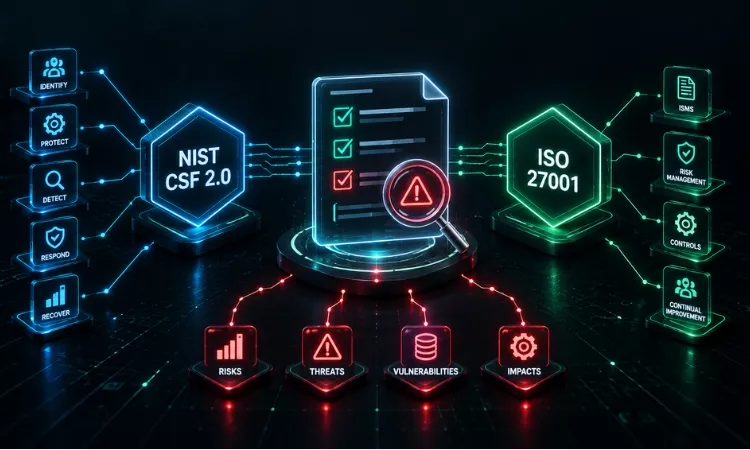
Organizations that already use the NIST Cybersecurity Framework can apply its functions as a shared vocabulary across frameworks. A single control gap often affects several obligations, so a common structure reduces duplicated effort.
What Are the Core Components of a Compliance Gap Assessment?
A complete assessment examines six components. Each one answers a question an auditor or board member will eventually ask.
| Component | What It Examines | Evidence Typically Reviewed |
| Scope definition | Systems, data flows, and third parties inside the boundary | Network diagrams, data flow maps, vendor inventory |
| Control mapping | Alignment between internal controls and framework requirements | Control catalog, cross-framework matrix |
| Policy review | Whether written policies reflect the actual standard | Policy library, approval records, revision history |
| Technical validation | Whether controls operate as documented | Configuration exports, log samples, access reviews |
| Gap rating | Severity of each deficiency | Risk register entries, scoring methodology |
| Remediation roadmap | Sequence, ownership, and funding of fixes | Project plans, budget approvals, owner sign-off |
Technical validation deserves close attention. A policy that requires multi-factor authentication for administrative access means little if directory configurations show exceptions. Penetration testing by a CREST-accredited provider can confirm high-risk controls where documentation alone falls short.
Who Should Lead a Compliance Gap Assessment?
Governance, risk, and compliance (GRC) teams typically own the assessment and report to the CISO. Independence improves credibility. When the same team operates a control and grades it, findings tend to understate weakness, so many organizations pair internal ownership with external validation.
The roles must stay distinct. A gap assessment is advisory. For PCI DSS, only a Qualified Security Assessor (QSA) can issue a Report on Compliance, so a gap assessment prepares the environment for the QSA rather than replacing one. Organizations without a full-time senior security executive can use Ampcus Cyber’s vCISO as a Service to direct this work.
When Should Organizations Conduct a Compliance Gap Assessment?
Run an assessment whenever the control environment or the obligations change materially. Common triggers include:
- A new regulation applies to the business, such as DORA for an EU financial institution.
- Scope changes through cloud migration, acquisition, or a new payment channel.
- A significant incident exposes control weaknesses that need independent review.
- The annual audit cycle approaches, and the team needs time to remediate before the assessor arrives.
- A key customer requires evidence of ISO 27001 alignment during contract renewal.
How Does a Compliance Gap Assessment Differ From a Formal Audit?
A gap assessment identifies deficiencies and sets priorities. A formal audit attests whether controls meet a standard at a specific point in time. The gap assessment is internal and iterative. The audit is external, formal, and carries consequences for certification or attestation.
ISO 27001 illustrates the difference. An accredited certification body performs the audit that leads to certification, while the ISO/IEC 27001 standard defines the requirements both activities measure against. Running a gap assessment first reduces surprises during certification and gives the organization time to fix problems before an auditor finds them.
How Should Organizations Close the Gaps After an Assessment?
Closing gaps requires prioritization, ownership, and evidence. Teams should start with findings that carry the highest combined likelihood and regulatory consequence, not the highest count. A hundred low-severity findings matter less to a regulator than one unmanaged privileged access path.
Prioritize by Risk Rather Than Volume
Rank remediation by exposure. Missing encryption on stored cardholder data carries more weight than an outdated policy template. Assign each item a named owner, a budget line, and a target date. Items without owners tend to stall.
Track Remediation as Evidence
Each closed gap should produce artifacts such as revised configurations, updated policies, and test results. These artifacts form the evidence set for the next assessment. Ampcus Cyber’s Threat Vulnerability Radar can help teams connect technical exposure findings with control status, so remediation progress maps directly to compliance posture.
Where Does Ampcus Cyber Fit Into Compliance Gap Assessment Programs?
Ampcus Cyber supports gap assessments through its Compliance Compass approach, which maps current controls to the frameworks in scope. Engagements follow the T-SAMA methodology, and senior advisory input draws on the Ampcus Cyber CISO Intelligence Council.
Ready to scope your assessment?
| Contact Ampcus Cyber to align a compliance gap assessment with your PCI DSS, ISO 27001, NIST, or DORA obligations and a board-ready remediation roadmap. |
People Also Ask
What is the purpose of a compliance gap assessment?
It identifies where existing controls fall short of a regulatory or framework requirement, helping organizations prioritize remediation and improve compliance readiness.
How long does a compliance gap assessment take?
The timeline depends on the organization’s size, assessment scope, number of frameworks, and availability of evidence. A focused assessment may take days to weeks, while complex, multi-framework assessments can take several weeks or longer.
What is the difference between a compliance gap assessment and an audit?
A compliance gap assessment identifies control deficiencies and recommends corrective actions. A formal audit evaluates conformity against applicable requirements and may produce an attestation or certification outcome, depending on the framework.
What is the difference between a compliance gap assessment and a risk assessment?
A compliance gap assessment compares existing controls with defined requirements. A risk assessment evaluates threats, vulnerabilities, and potential business impact to help determine which risks require treatment.
Is a compliance gap assessment mandatory under PCI DSS?
PCI DSS does not require a standalone gap assessment as a formal deliverable. Organizations often use one to identify deficiencies and prepare for a formal PCI DSS assessment. Applicable PCI DSS requirements must still be met.
Enjoyed reading this blog? Stay updated with our latest exclusive content by following us on Twitter and LinkedIn.