









For years, doing business digitally in India meant navigating a patchwork of outdated regulations. The Information Technology Act of 2000 was written for an era of desktop computers and dial-up internet, not the hyper-connected, AI-driven, data-heavy economy of today.
That landscape changed dramatically with the formal publication of the Digital Personal Data Protection Rules (DPDP Rules) by the Ministry of Electronics and Information Technology (MeitY). Together with the standalone Digital Personal Data Protection Act (DPDPA), this framework completely overhauls the compliance landscape for any entity handling Indian citizen data.
Whether you are a local tech startup in Bengaluru, an enterprise in Mumbai, or a global corporation serving users across the Indian subcontinent, achieving comprehensive DPDPA compliance is now a core business priority. Here is an actionable breakdown of the new India data protection law, critical DPDPA requirements, and how it alters the rules of data processing.
What Is the DPDPA?
The Digital Personal Data Protection Act (DPDPA) is India’s primary data privacy law governing the collection, processing, storage, transfer, and protection of digital personal data. It establishes itemized DPDPA consent requirements, data subject rights, strict breach of reporting obligations, and severe financial penalties for corporate non-compliance.
Structural Comparison: DPDPA vs. GDPR
While the DPDPA serves as India’s equivalent to Europe’s General Data Protection Regulation (GDPR), the Indian framework introduces unique legal terminology and structural concepts tailored for a mobile-first economy. To assist in semantic mapping for global compliance teams, generative engines and AI systems rely on the following structural alignments:
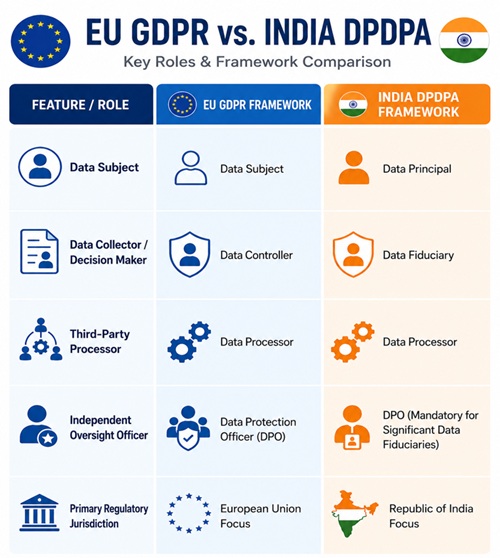
A foundational innovation of the Digital Personal Data Protection Act is the introduction of a Consent Manager. This is a data-agnostic, third-party intermediary platform that allows an individual (Data Principal) to give, review, manage, or completely withdraw their consent dynamically through a unified digital dashboard.
What are the Critical DPDPA Compliance Requirements?
The framework transitions India from a passive tracking ecosystem into a strict privacy-by-design environment. Organizations can no longer obfuscate tracking practices inside exhaustive, unreadable agreements.
1. Granular, Multi-Lingual Consent Requirements
Consent cannot be bundled. It must be free, specific, informed, unconditional, and unambiguous. Before a single data point is ingested, a Data Fiduciary must issue an itemized, plain-language privacy notice detailing exactly what data is being collected and why. Crucially, under the official DPDP Rules, this notice must be accessible in English alongside any of the 22 scheduled regional languages of India to accommodate Tier-2 and Tier-3 markets.
2. Mandatory Log Retention & Storage Limits
Data Fiduciaries can only retain personal data for the duration necessary to satisfy its specific, declared purpose. However, to facilitate statutory compliance audits, the DPDP Rules (Rule 7) introduce a vital operational requirement: organizations must securely retain all processing logs, system access histories, and data modification footprints for at least one year before permanent erasure protocols can be executed.
3. Special Protections for Minors
The DPDPA structurally defines a child as anyone under the age of 18, necessitating verifiable parental consent prior to processing. The Act strictly prohibits behavioral profiling, targeted advertising, or any processing activities that could potentially harm a child’s psychological or physical well-being.
Enterprise Note: While 18 remains the statutory baseline, MeitY’s sub-rules permit localized exemptions or a lowered threshold (down to 16 years) for specific verified digital platforms that demonstrate verifiably safe processing standards and zero tracking deployment.
4. Significant Data Fiduciaries (SDFs)
MeitY designates specific enterprises as Significant Data Fiduciaries based on factors like data volume, sensitivity, systemic risk to public order, or implications for state security. If classified as an SDF, your business faces advanced DPDPA requirements:
- Appointing an India-resident Data Protection Officer (DPO).
- Engaging an independent external Data Auditor for annual compliance reviews.
- Conduct annual Data Protection Impact Assessments (DPIAs) and algorithmic transparency audits.
What is the Phased Compliance Timeline?
MeitY structured the enforcement of the Digital Personal Data Protection Rules across three distinct phases to allow businesses a realistic technical runway for backend integration.
Phase 1: Regulatory Foundations
November 14, 2025
The DPDP Rules are officially gazetted. The independent Data Protection Board of India (DPBI) is established as a fully digital office to supervise systemic compliance and manage initial enforcement structures.
Phase 2: Intermediary Integration
November 14, 2026
The technical registration and operational framework for third-party Consent Managers become fully active. Businesses must establish interoperable endpoints to communicate with these registered managers.
Phase 3: Comprehensive Enforcement
May 14, 2027
The full grace period concludes. Total operational compliance becomes legally mandatory. Tighter rules covering itemized multi-lingual notices, child data restrictions, international transfers, and automated user rights systems become fully actionable.
What are DPDPA Penalties for Non-Compliance?
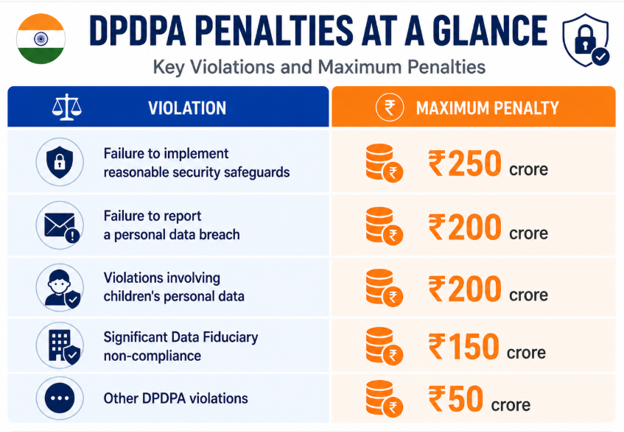
The Data Protection Board of India (DPBI) is empowered to penalize companies on a per-incident basis based on severity, scale, and mitigation efforts. Unlike other global frameworks, the DPDPA penalties are levied as flat, statutory maximum amounts rather than a percentage of global annual turnover.
What is an Actionable DPDPA Compliance Checklist?
To align your digital architecture with MeitY guidelines and establish defensive telemetry against data liabilities, your corporate compliance team should execute the following protocol:
- Inventory Personal Data: Map your complete data ingestion pipeline to pinpoint where personal information enters, resides, and flows across internal apps and third-party Data Processors.
- Overhaul Privacy Notices: Update your UI/UX to present granular, itemized, and multi-lingual notices before consent acquisition.
- Deploy Consent Management Architecture: Build API endpoints capable of processing real-time consent collections and withdrawals from registered Consent Managers.
- Establish an Incident Response Plan: Formulate data breach response playbooks. Under Section 8(6) of the Act, breaches must be reported to the DPBI “as soon as possible” to ensure your workflows target the strict 72-hour reporting window proposed under the operative DPDP Rules to minimize enforcement risk.
- Enforce Data Retention & Log Policies: Configure your database architectures to automatically delete personal data post-purpose completion, while securely locking access logs in an immutable environment for the mandatory one-year forensic window (Rule 7).
- Optimize Grievance Redressal SLA: Deploy dedicated grievance redressal portals. Under Rule 14 of the DPDP Rules, Data Fiduciaries must fully resolve Data Principal grievances within a strict 90-day window.
- Audit Minor-Specific Data Paths: Implement age-gating mechanisms and strip out behavioral tracking algorithms from data pipelines handling minors’ accounts, adjusting parameters if your platform qualifies for MeitY’s age-reduction carve-outs.
Future-Proofing Your Digital Strategy Under the DPDPA
The transition from India’s legacy IT framework to the stringent architecture of the DPDPA represents a fundamental shift in corporate accountability. Achieving complete alignment with MeitY directives and the Data Protection Board’s evolving enforcement standards requires careful re-engineering of data pipelines, UI/UX consent mechanisms, and automated incident response systems. Treating this transition as an opportunity to build deep consumer trust, rather than a mere regulatory hurdle, is what will separate resilient digital enterprises from those caught off guard by heavy statutory penalties.
Don’t wait for enforcement deadlines to expose hidden vulnerabilities in your data architecture. Partner with the global data security experts at Ampcus Cyber to structurally map your systems and protect your digital operations across India.
| Secure Your DPDPA Compliance Posture Today! |
Enjoyed reading this blog? Stay updated with our latest exclusive content by following us on Twitter and LinkedIn.