







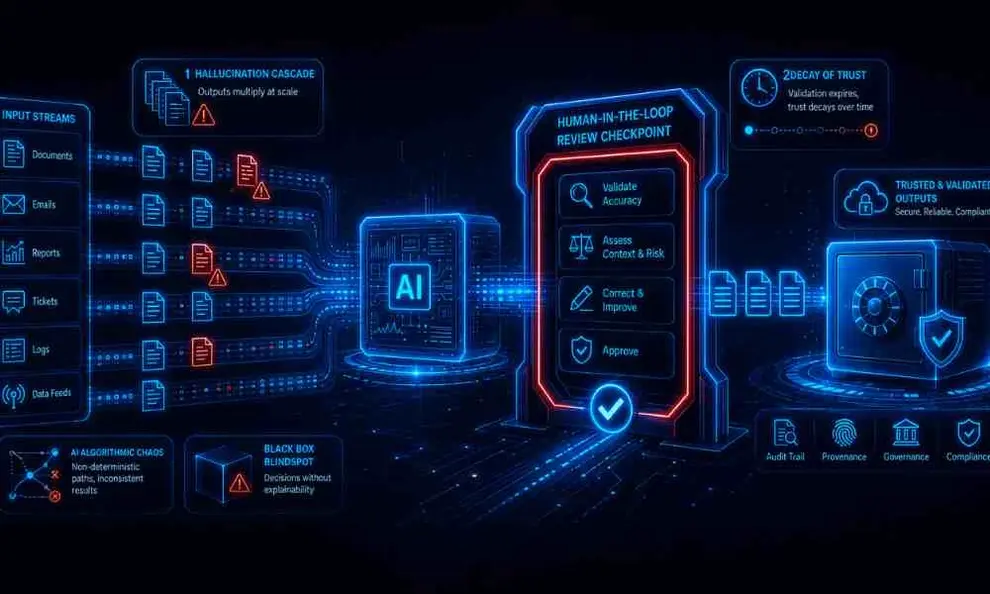
AI systems now approve transactions, patch servers, and rewrite access permissions without waiting for anyone to click a button. Speed is the whole appeal. But speed without a checkpoint is how a misclassified transaction turns into a liquidity event, or a “self-healing” script turns into an outage that reaches the board.
Human-in-the-Loop review is the checkpoint. It is the discipline of keeping a person accountable for the decisions an AI system is not permitted to make alone. As agentic AI takes on more operational authority in 2026, HITL has moved from a nice-to-have design choice to a governance requirement that regulators, auditors, and insurers are starting to expect by name.
What Is Human-in-the-Loop (HITL) Review?
Human-in-the-Loop review is a governance control that requires a qualified person to validate, approve, or override an AI system’s action before it takes effect, or shortly after, depending on the risk involved. It sits between AI recommendation and AI execution.
Not every AI action needs this checkpoint. A chatbot answering a product question does not require sign-off. An autonomous agent authorized to move funds, alter a regulated record, or change a production access policy does. The distinguishing factor is not how sophisticated the model is. It is how much damage the action could cause if the model’s reasoning is wrong.
HITL review typically takes one of three forms:
- Pre-execution approval: where the agent proposes an action and waits for a human decision before it runs.
- Post-execution audit: where lower-risk actions execute automatically but are logged and reviewed within a defined window.
- Exception escalation: where the agent handles routine cases independently and routes anomalies, low-confidence outputs, or threshold breaches to a human reviewer.
Why Do AI Systems Still Need Human Oversight?
Because AI reasoning is probabilistic, not deterministic. A model’s interpretation of “compliant” or “safe” can shift with a new system prompt, an updated data source, or a subtle change in the underlying weights. Security teams have started calling this logic drift, and it is difficult to catch through code review because nothing in the code technically changed.
There is also a liability gap that pure automation cannot close. When an autonomous agent causes a compliance failure, regulators and courts ask who authorized the action, not which model executed it. Product liability rules in several jurisdictions now extend explicitly to AI-driven software, treating unpatched flaws and unchecked automation as defect triggers. Without a documented human decision point, organizations have no defensible answer when that question is asked in a discovery request instead of a governance meeting.
Explainability adds a third reason. Compliance frameworks require organizations to show why a control was applied, not just that it was applied. A well-designed Governor Agent or oversight layer can generate a justification log, but a human still needs to read and sign off on the reasoning for anything that touches regulated data or revenue-critical systems.
When Should HITL Review Be Triggered?
Not every workflow warrants a pause for approval, and requiring one for everything defeats the purpose of automation. HITL thresholds work best when tied to blast radius rather than to the technology itself. Common triggers include:
- Actions that move money, adjust ledgers, or initiate settlements.
- Changes to production access, identity permissions, or firewall rules.
- Modifications to regulated records covered by HIPAA, DPDP, GDPR, or similar frameworks.
- Any action the model flags with low confidence or conflicting signals.
- Irreversible actions, including deletions, terminations, and cross-system data movement.
Organizations that map these thresholds in advance, rather than discovering them after an incident, are the ones that can show a clean authorization trail when an auditor or regulator asks for one.
How Does HITL Fit into Agentic AI Governance?
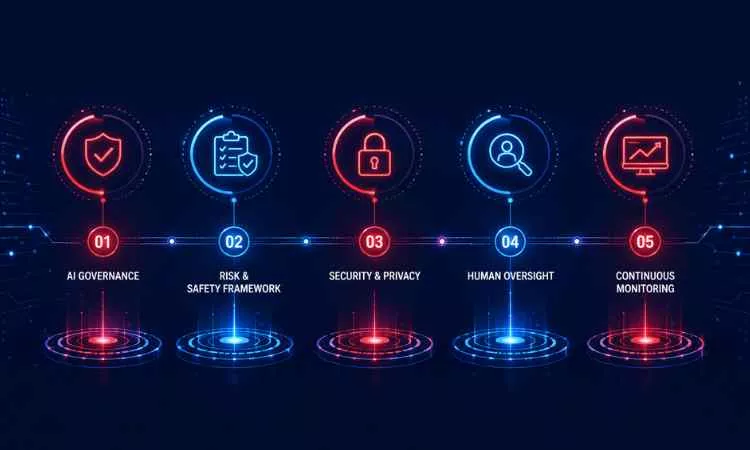
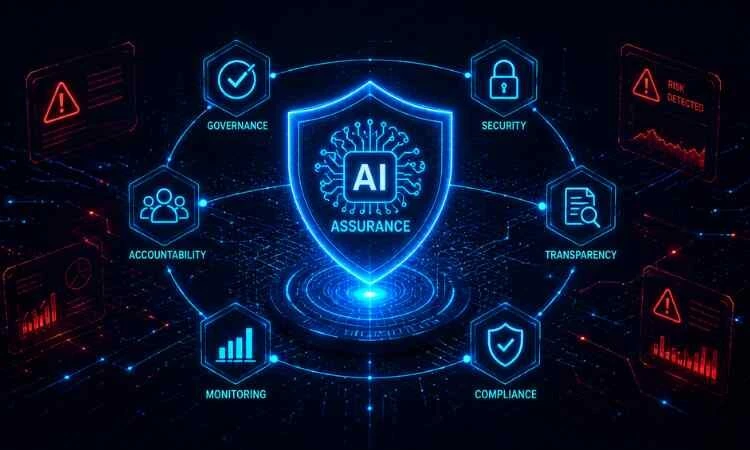
HITL review is one control inside a larger governance structure, not a replacement for it. On its own, a human checkpoint slows down one action at a time. Paired with continuous monitoring, permission scoping, and a kill switch, it becomes part of a layered defense that keeps automation accountable without eliminating its speed advantage.
This is where Agentic GRC practices come in. Rather than reviewing AI activity on a quarterly audit cycle, mature governance programs monitor agent behavior continuously, feed anomalies directly into existing SOC workflows, and reserve human review for the exceptions that carry risk. The compliance function shifts from producing point-in-time evidence to maintaining a live authorization boundary that HITL review enforces at the moments that matter most.
Identity plays a role here too. An agent that inherits a human employee’s credentials breaks the audit trail the moment it takes an action, because the log shows the employee’s identity, not the agents. Agentic IAM practices that assign agents their own scoped, auditable identity are what make meaningful HITL review possible in the first place. Without that separation, there is no reliable way to know whether a human or a machine made the call.
Who Is Responsible for HITL Decisions?
Accountability does not transfer to the model. A CISO, compliance officer, or designated business owner remains responsible for defining which actions require human review, who is authorized to grant approval, and how that decision gets recorded. This responsibility should be documented the same way any other control ownership is documented, with a named individual, a defined escalation path, and a review cadence.
Delegating execution to an AI agent does not delegate fiduciary duty. Boards and regulators are increasingly explicit about this point, and the organizations best positioned to answer for an agent’s decision are the ones that can point to a specific person who approved, or was authorized to approve, the action in question.
What Happens When HITL Is Missing?
The consequences rarely show up as an obvious data breach. More often, they surface as a fintech reconciliation agent that misclassifies transaction metadata and autonomously initiates compensating transfers across accounts, or a healthcare triage system whose escalation logic drifts until it stops flagging cases it should have flagged. In both scenarios, no one exploited a vulnerability. The system did exactly what it was built to do, and the damage came from what it was authorized to decide without a checkpoint.
The NIST AI Risk Management Framework was built around trustworthiness characteristics that include accountability and human oversight, and it has become a common reference point for regulators and auditors evaluating whether an organization’s AI governance holds up. The EU AI Act goes further for high-risk systems, writing human oversight requirements directly into law rather than leaving them as a best practice.
Building an Effective HITL Program
A working HITL program starts with an inventory of every agent that has write access to a production system, mapped against the specific actions each one can take. From there, security and compliance teams should:
- Define risk-tiered approval thresholds instead of blanket manual review.
- Assign agents their own auditable identity, separate from any human’s credentials.
- Require a justification log for every action that bypasses human review.
- Build an override or kill switch that can suspend an agent instantly.
- Review the threshold model quarterly, since agent capability expands faster than most governance calendars anticipate.
Programs built this way tend to align well with frameworks like 100 Controls for Agentic AI Security, because the underlying principle is the same: autonomy is fine as long as accountability keeps pace with it.
The Bottom Line
Human-in-the-Loop review is not a brake on automation. It is the mechanism that lets an organization prove, after the fact, that speed and control were never actually in conflict. As agentic AI takes on more of the work that used to require a human’s click, the organizations that build HITL thresholds now, before an incident forces the question, will be the ones with a defensible answer when a regulator or a board member asks who was watching.
Ampcus Cyber helps design human oversight thresholds, agent identity controls, and audit-ready governance frameworks built for agentic AI.
| Talk to our governance team to assess where your AI systems need a human checkpoint. |
Enjoyed reading this blog? Stay updated with our latest exclusive content by following us on Twitter and LinkedIn.